Been awhile since we've had an update around here because I've been knee-deep in the final phases of production for my new novel Rift Jump Volume 2: Sara's Song. I'm happy to report that we're almost there! The e-book will most likely be online this week, with the paperback soon to follow--if not released simultaneously. Ironing out all the kinks and getting it ready to unleash upon the world.
Sara's Song is meant to be the capper to my wild little ride through the multiverse and, believe me when I say, this is the biggest project I've ever done. There's some mind-bending, reality-warping, galaxy-shattering goodness going on in this thing. Think Lovecraft meets Star Wars with teen love thrown in the mix, all wrapped in a comic book package. This is a fantasy epic I've been working on since high school and I'm excited to share it with you all.
In the meantime, now is the perfect time to get caught up on the Rift Jump saga. The Revised and Expanded Edition is now available in print and e-book. Check it out and stay tuned for the big release of the epic finale!
Showing posts with label H.P. Lovecraft. Show all posts
Monday, June 8, 2015
Friday, April 19, 2013
Adios and Shalom: Looking Back At The Merkabah Rider Series
Today we're doing things a little different 'round here. 2013 was a big year for me, seeing the completion of The Coming Evil Trilogy--but 2013 also marks the end of the critically acclaimed and brilliant Merkabah Rider series written by my pal Ed Erdelac. In honor of this momentous occasion, I've asked Ed to stop by the blog and share his journey, taking us from the Rider's inception, to the final chapter in his tale. It's a great read and should prompt you to immediately run out and buy all four books!
Take it away, Ed!
I also found an illustration by Gustave Dore for John
Milton’s Paradise Lost, The Empyrean,
which depicted the Heavenly Host turning as a great wheel or flock around the
brilliant presence of God in the middle. It’s at once beautiful and harrowing.
Immediately my brain conjured this image of a Hasidic Jew in long black coat and hat, riding a horse made of flame.
Only a year earlier I had discovered H.P. Lovecraft, and
was thinking a lot about the deities of his indifferent universe. I needed a
foe for the Rider to face, but the Jewish view of the Devil is quite different
from Christianity’s. Satan is not directly opposed to God. He works for God,
testing the souls of man and maintaining Sheol/hell as a crucible for the human
spirit. He’s not the blasphemous entity popularized in horror films and books.
Take it away, Ed!
-----------------------------
This month saw the release of Merkabah Rider 4: Once Upon A Time In The Weird West, the last installment of my Judeocentric weird western
series.
For those unfamiliar with it, it’s about a Hasidic
gunslinger tracking the renegade teacher who betrayed his mystic Jewish order
of astral travelers to the Great Old Ones of the Lovecraftian Mythos. Along the
way, the Rider (so-called because members of his order, The Sons of The
Essenes, assume a title to obfuscate their true names from malevolent spirits)
encounters half-demon outlaws, a mystic cannon, a brothel full of antediluvian
succubi, shoggoths, invisible monsters, Doc Holiday, zombies, an undead gunfighter
constructed from the body parts of famous outlaws, and a pissed off animated
windmill among other dangers.
Beyond the weirdness and adventure, it’s also a story
about the testing of a man’s faith in the face of overwhelming cosmic horror
and indifference, and, at its core, I like to think, the beneficial nature of
tolerance.
The stories of the
Rider started for me in high school. I had just read Robert E. Howard’s stories
The Thunder Rider, Old Garfield’s Heart, and
The Horror From The Mound, and I was
thinking about writing weird westerns. I tried my hand at a few, two of which
show up greatly expanded upon in Tales Of A High Planes Drifter (namely The
Dust Devils and Hell’s Hired Gun).
In their original incarnation, the hero of those stories was an ex-soldier, an
objector to the heinous Sand Creek Massacre who was shot and left for dead by
his comrades, and rescued by a Cheyenne medicine man who sewed a mystical hide
shirt to his skin that allowed him to shrug off bullets. I wrote a couple more of these featuring that
character “The Ghost Dancer,” but I lost interest after a bit as The Dancer’s
mission was solely vengeance bent, and not really very engaging. I wasn’t ready
yet to create a compelling central character.
I think my seeing the TV series Kung Fu when it was rerun on TNT in freshman or sophomore year of
college planted the seed in my mind for a fish out of water individual
traveling through the west, but it wasn’t till nearly ten years later, when I
had moved to an orthodox Jewish neighborhood and my wife picked up an
angelology book (Angels A To Z) that
the Rider finally reared full blown into my mind.
I came across this entry –
Merkabah Rider – An
ancient Jewish mystic who fasted and prayed to reach an ecstatic trance. While
in this trance state, he sent his soul upward through the heavenly halls in an
attempt to reach the Throne of Glory that is supported by the chariot of
Merkavah (the fiery vehicle seen by Elijah). The objective of the Merkabah Rider was to join himself with the Universal
Soul. During this journey, the Rider was constantly plagued by demons. The Merkabah Rider used prayer,
magical talismans, incantations, and asceticism to enlist the aid of angels,
who would protect him throughout his journey and ultimately defeat his
antagonists.
Immediately my brain conjured this image of a Hasidic Jew in long black coat and hat, riding a horse made of flame.
I started tackling Jewish folklore and mysticism, reading
everything I could. Little details began to fit into place. The Rider’s
mystically embossed blue glass spectacles, etched with Solomonic seals that
allowed him to look into the spirit world at its unseen denizens. His adorned
Volcanic pistol (a favorite design of firearm for me – the protagonist of my
straight, no ghoulies western novel Buff Tea carries one), the mystic symbols allowing him to carry it into the
astral plane. Much of his asceticism I took from Jewish kashrut or kosher
teaching, but some I culled from Kung
Fu’s shaolin monks (the Rider’s refusal to ride a horse, for instance).
Only a year earlier I had discovered H.P. Lovecraft, and
was thinking a lot about the deities of his indifferent universe. I needed a
foe for the Rider to face, but the Jewish view of the Devil is quite different
from Christianity’s. Satan is not directly opposed to God. He works for God,
testing the souls of man and maintaining Sheol/hell as a crucible for the human
spirit. He’s not the blasphemous entity popularized in horror films and books.
So I got to thinking, that in an ordered universe, the
ultimate nemesis would be chaos. And in researching Jewish mystic thought, I
came across another passage (in the fantastic reference The Encyclopedia of Jewish Myth Magic and Mysticism) –
Rahav – A cosmic
sea monster first mentioned in the biblical book of Isaiah….God slew him when
he refused to help in creating the earth. The oceans conceal the lethal stink
of his carcass, which is why the sea smells so strange.
Sounds like Cthulhu, right?
So then reading more, I found references to a forbidden
area of mystic study, that which precedes Creation – the Olam ha-Tohu, The
World of Chaos.
I had found my heavy for the Merkabah Rider series, and
the more I researched and read, the easier things began to fit in with each
other. That’s when I know I’m on to something – when I don’t have to force
anything. When references just start making themselves known to me.
For a direct physical villain, again, the character just
made himself known to me. I was watching a lot of Doctor Who and enjoyed the character of The Master – a
diametrically opposed Time Lord and foil for The Doctor. I decided a failed
Merkabah Rider who worships chaos might be interesting, so I came up with Adon
(whose name means “Master” or “Lord”). When the time came to present a story
for Adon, I happened to read the Jewish fable of the sages who entered
Paradise.
Four men entered the pardes — Ben Azzai, Ben Zoma, Acher [that is, Elisha ben
Abuyeh], and Akiba. Ben Azzai looked and died; Ben Zoma looked and went mad;
Acher severed the root; Akiba entered in peace and departed in peace.
In some mystic
schools of thought, our souls or astral selves are bound to this world by an
astral tether which reaches from the corona of our head.
In the world
of Merkabah Rider, I had established
that this tether anchored the soul to the body and thus the physical world. It
was a root, and Elisha ben Abuyah had cut it. He had severed himself from his
body, but because he had done so before the Throne of Glory, he had somehow
gone on (perhaps due to Merkabah Rider training), a disembodied spirit, able to
possess other’s physical forms.
But what had
the Sages seen that had caused such drastic reactions?
I decided, the
Outer Gods, slumbering in the world of Chaos that bordered the universe as created
by God.
What would
such knowledge do to the Rider? That became a central point of the series.
Could the Rider maintain his faith? Would it change anything for him? Would he
go the route of Adon?
In the meantime, I could let my imagination run wild, and
I did, borrowing or adapting creatures and people from folklore and literature
(Ambrose Bierce’s Damned Thing shows
up as a servant of the Old Ones in The
Damned Dingus) history, and the Bible, and exploring my love of the Old
West at the same time.
It was a wonderful experience, writing Merkabah Rider,
and the positive response it’s received from those who have read and enjoyed it
are very dear to me – particularly the unsolicited reader reviews on sites like
Amazon, Goodreads, Facebook, LibraryThing, and Shelfari.
I want to share just a few that I treasure –
“It is, quite
simply, one of the coolest things I've ever read. It feels like something
tailor made for me, and it feels genuine and sincere.”
“The best book I read last year. You don't need to
like westerns to like his work--he is a genius. The Merkabah Rider Series is
better than investing in gold. It will make you feel awesome inside---like
maybe you finally read a book that meant something---he is that good.”
“This is great--no,
stupendous adventure fiction, the kind that I often crave and rarely find.”
There are just a few, and I post them not to inflate my
own ego, but because they mean a great deal to me, as all of them do. Even the
negative ones. These are people that went out and bought the book on their own
and got something from it, and in the age of file sharing and buying and
selling reviews, that’s something to me.
Now I just hope nobody retracts their previous good
opinions when they’ve read the last one.
In closing, it’s been a wonderful trip writing Merkabah Rider. There are still small
stories about the Rider that can be told (one, The Shomer Express, has already appeared in anthology called The Trigger Reflex), and characters from
the series might still appear here and there in related works, but for now, I
turn my attention to other things.
The Rider and his onager walk off into the sunset.
Labels:
cthulhu,
Edward M. Erdelac,
H.P. Lovecraft,
Merkabah Rider,
weird west
Monday, April 8, 2013
"Dark Hour" Commentary--Part III
Hey, all. Today's the third and final installment in my commentary for Dark Hour. As always, the following is filled with spoilers for Dark Hour, so read no further if you've yet to read the book and want to be surprised.
Again I say WARNING: SPOILERS BELOW!
Still here?
If The Strange Man was my love letter to '80s monster movies like Fright Night and The Monster Squad, and Enemies of the Cross was my turn at The X-Files, then Dark Hour was certainly my ode to Lovecraftian terrors. In essence with Book Three, I wanted to write a full blown monster war. It is the Apocalypse--at least as far as the small town of Greensboro is concerned. We have men turning mad and becoming shambling monstrosities, we have the lake being possessed of sin sludge and turning into this giant pillar of tentacles that lash out at everything. There's a man who becomes a winged gargoyle. Rosalyn, herself, sprouts a cancerous growth that has eyes and teeth and tentacles.
It's some pretty gross, terrible stuff.
And I loved writing every bit of it.
I came to know of horror author H.P. Lovecraft and his Cthulhu Mythos in my early to mid twenties. Perhaps my first exposure to the Cthulhu mythos wasn't Lovecraft at all, but rather John Carpenter's In the Mouth of Madness which was sort of an homage to all things Lovecraftian.
I didn't get this movie at all when I first saw it as a teen. I thought it was weird and didn't make any sort of logical sense, and was just maddening. But, hitting my twenties, I deduced that was the beauty of Lovecraft's work. He writes of Evil older than man, awakening outside the stars, and coming to reclaim the Earth. It's nihilistic, shrouded in mystery and terrible vagueness, with this poetic sense of impending doom. I get a kick out of Lovecraft, despite his dark subject matter. His stories are made up of the very best of ghost stories told around a flashlight or campfire, as there's never any real resolution--just the sense that IT is "out there" and IT is "coming soon".
In Dark Hour, I wanted to essentially write my take on a Lovecraftian tale, but fusing it with Scripture and the sort of Biblical underpinning that The Coming Evil Trilogy was built on. There's madness and tomes of strange unpronounceable words and this promise that some Dark Master is coming to "change" the world of men, turning them into monsters.
Yet, as you read Dark Hour, you will discover it's all the Strange Man's ploy. It's a joke. There IS no uber-monster, no apocalypse--except that which we bring on ourselves. And that's where Dark Hour diverges from Lovecraft. I'm a firm believer that Mankind is a great evil unto itself. In true Lovecraft fashion, the characters in Dark Hour are looking to the stars in dread, fearing what monster is out there--however, they have yet to realize that THEY are the monsters, and they always have been. That's where Christ comes in. To destroy the real monsters, we have to destroy the sin within ourselves, and we can only truly do that by being made new through Christ.
Dark Hour is about a war with monsters, but a war fought without guns or magical swords or talismans. It is fought with faith, hope, and love. Patience and mercy and kindness. It was super important to me that Biblical principles save the day, rather than human might--but let me tell you, that was not easy writing these huge battle sequences where my heroes have no weapons!
In the end, the only thing that can save us from destruction, is simple repentance.
As I understand it, Lovecraft was an atheist. Indeed, his monsters are not demons, as some Christian critics have supposed, but simply alien beings that are above the simple minds of man. What is interesting about Lovecraft's writings is that religion and science, both, break down in the face of such unspeakable creatures. His stories convey a mood of hopelessness, but, in a weird way, I find them incredibly hopeful. Because, as a theist, I believe that nothing is outside of God. And, in my own life, I discover that the more "mundane" a situation is, the more I worry about it. I worry about fixing things that I know I can fix. I stress over bills, over deadlines, over getting to places on time--all things I have some semblance of control over. But it's the big things that bring me to God. I see that I am incapable of fixing something so huge and it sends me running, fully reliant on God.
What could be more huge than the Apocalypse of Great Old Ones returning to Earth? :p So, in a weird way, Lovecraft doesn't tear down my belief in a God who will protect me, but causes me to consider that, should such catastrophes be on the horizon, I can only find solace in God. That was what I wanted to convey in Dark Hour. In the face of The End of All Things, our heroes can't really turn the tide by punching some giant tentacled beast in the eye. The only thing they can control is how they're going to go out: fighting with dignity, with honor, with courage, with love, with hope--and leave the rest up to God.
In the end, I suppose that's all any of us can do.
Thanks for hanging around as I poke at the book a bit. Certainly there's much more to discover in Dark Hour, indeed the entire Coming Evil Trilogy, than I can cover in three simple commentary installments, but I'm anxious for you all to discover them yourselves!
With that, this concludes the commentary for all three books. The Trilogy is finished! I'm still reeling from that revelation as I spent so long working on it. Thank you all for reading and, for those who haven't started yet, all three books are available to your immediate right. Check them out!
Labels:
Christian Horror,
cthulhu,
dark hour,
H.P. Lovecraft
Wednesday, September 5, 2012
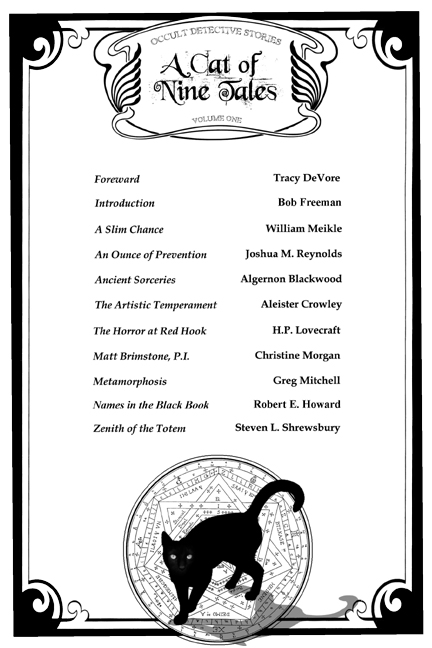
Available Now--A Cat of Nine Tales!
Today I am very excited to announce that my latest chiller story--and the debut of my own occult detective, Vinnie Caponi: Urban Mythologist--"Metamorphosis" is now available in Rookhaven's Publishing A Cat of Nine Tales.
You want Guns, Ghouls, and Grimoires? Well, look no further. Collected here are nine supernatural thrillers — from Algernon Blackwood, Aleister Crowley, Robert E. Howard, H.P. Lovecraft, William Meikle, Greg Mitchell, Christine Morgan, Joshua M. Reynolds, and Steven L. Shrewsbury — guaranteed to satisfy your thirst for mystery, suspense, and esoteric adventure.
Occult Detective Stories, Volume One — A Cat of Nine Tales — Edited by Tracy DeVore & Thaddeus Sexton, with illustrations by Bob Freeman.
It is such a huge honor to be included in this anthology and a dream come true to be included in a book with Lovecraft himself. Click the link to order your copy RIGHT NOW. It's the perfect thing to prepare you for the Halloween season. And for a neat sneak peek into what you will find in this anthology, head over to my pal Bob Freeman's site and read the first paragraphs of all the stories!
Here's the first paragraph of my contribution "Metamorphosis"--Josh Banks turned his key and entered the country shack. The place seemed colder these days without her there. On the wall, where portraits of her pretty face once smiled back at him, there was only bare wood paneling. Vinnie had already removed all the painful reminders of her beauty, her warmth. Dirty clothes lay draped over furniture and empty bottles of Bourbon were scattered on the carpet, but what bothered Josh most were the stacks of strange books. Vinnie’s new obsession.
You want Guns, Ghouls, and Grimoires? Well, look no further. Collected here are nine supernatural thrillers — from Algernon Blackwood, Aleister Crowley, Robert E. Howard, H.P. Lovecraft, William Meikle, Greg Mitchell, Christine Morgan, Joshua M. Reynolds, and Steven L. Shrewsbury — guaranteed to satisfy your thirst for mystery, suspense, and esoteric adventure.
Occult Detective Stories, Volume One — A Cat of Nine Tales — Edited by Tracy DeVore & Thaddeus Sexton, with illustrations by Bob Freeman.
It is such a huge honor to be included in this anthology and a dream come true to be included in a book with Lovecraft himself. Click the link to order your copy RIGHT NOW. It's the perfect thing to prepare you for the Halloween season. And for a neat sneak peek into what you will find in this anthology, head over to my pal Bob Freeman's site and read the first paragraphs of all the stories!
Here's the first paragraph of my contribution "Metamorphosis"--Josh Banks turned his key and entered the country shack. The place seemed colder these days without her there. On the wall, where portraits of her pretty face once smiled back at him, there was only bare wood paneling. Vinnie had already removed all the painful reminders of her beauty, her warmth. Dirty clothes lay draped over furniture and empty bottles of Bourbon were scattered on the carpet, but what bothered Josh most were the stacks of strange books. Vinnie’s new obsession.
Monday, June 11, 2012
New Project--A Cat of Nine Tales
I was pleased to get the notification this morning that my short story "Metamorphosis" had been selected as part of the offerings for Rookhaven Publishing's forthcoming "A Cat of Nine Tales" anthology of occult detective stories. Taking one look at the table of contents, though, left me quite stunned.

Wait, I'm sorry. Blackwood? Howard? Lovecraft? And...Mitchell? You'll have to forgive me for totally geeking out. Sharing page space with such an impressive and inspiring group of occult writers is a thrill and certainly one I never expected. So what can you expect from my contribution to this spooky new collection? "Metamorphosis" is the world's introduction to my own occult detective hero--the self-labeled "Urban Mythologist" Vinnie Caponi. I've had Vinnie kicking around in my head since the early '00s and I have some pretty big plans for him in my uber-mythology. But here, in A Cat of Nine Tales, you will get a peek into his humble beginnings. I'm thrilled to be a part of this project and I hope everyone checks it out when it releases...this Halloween!

Wait, I'm sorry. Blackwood? Howard? Lovecraft? And...Mitchell? You'll have to forgive me for totally geeking out. Sharing page space with such an impressive and inspiring group of occult writers is a thrill and certainly one I never expected. So what can you expect from my contribution to this spooky new collection? "Metamorphosis" is the world's introduction to my own occult detective hero--the self-labeled "Urban Mythologist" Vinnie Caponi. I've had Vinnie kicking around in my head since the early '00s and I have some pretty big plans for him in my uber-mythology. But here, in A Cat of Nine Tales, you will get a peek into his humble beginnings. I'm thrilled to be a part of this project and I hope everyone checks it out when it releases...this Halloween!
Saturday, August 21, 2010
"Weird" Interview with Michael Vance!
Back in 2007, I had just released the self-published version of "The Coming Evil" and, in the words of Old Ben Kenobi, I was beginning to take my first steps into a larger world. I joined the Lost Genre Guild, a haven for Christian sci-fi/fantasy/horror writers. It was during this time that I met Michael Vance and discovered his Light's End stories.
For years I thought I was the only "Christian Horror" writer in the world, but Michael had been working in this genre for decades. We started corresponding and I read some of his Light's End stories and, I tell you, they could have been found in the pages of the original Weird Tales. They were pulp, and classic, and very much the contemporary of the works of Lovecraft, Bradbury, and Wellman.
It's no wonder then, that when his Light's End stories finally got their due and were picked up by Airship 27, that they were packaged into a "braided novel" appropriately titled Weird Horror Tales.

The first volume was released in February of 2009, and since then, I've been wanting to do an interview with Michael. I am endlessly fascinated by the craft and care he's put into his Light's End mythology--one that no doubt rivals the Cthulhu Mythos in unnameable dread--but time is elusive. This week, however, he announced the upcoming release of the second volume of Weird Horror Tales, and I knew now was my chance to pick his brain.
Michael did me the honor of sitting down and discussing the books and the origins of his massive continuity.
GM: What's the story behind Weird Horror Tales? What's it all about?
MV: Light's End is a town without God, and the overarching theme is what that would actually look like if it were true. For me, that would be the ultimate horror.
GM: It's described as a "braided novel". For those who don't know, how is that different from an anthology?
MV: While each story stands on its own legs, so to speak, it is also interlinked to all of the other stories in the series by setting, overarching theme, town history, a few repeating characters, and style. Each story was also meant to be a chapter that progresses a larger story creating a novel. In this case, these stories were always meant to end up as a trilogy of novels. But each book can be read alone and enjoyed.
GM: Light's End has an incredible timeline. Exactly how many years of the town do you have mapped out?
MV: Approximately 400 years at this writing.
GM: How long have you been writing Light's End stories?
MV: I’ve been writing the prose stories for about twelve years. The first Light’s End comic book stories predate the prose short stories. They were written in the 1980s.
GM: Let's go back to the beginning--what's the genesis of your "love affair" with Light's End? How did all this start for you?
MV: Horror is my favorite genre. In years past, I wrote several eight page horror stories for comic books. I also wrote a few within the larger framework of a comic strip I did for five years called “Holiday Out”. In fact, I wrote “Holiday Out” while working for the newspaper in the town that serves as the template for Light's End. These stories directly and indirectly lead to the creation of my fictional town.
The first Light's End comics stories were "Where Bright Angel Feet Have Trod" (first published in a magazine), "In The Out Door" (magazine), "Wishful Thinking", and "The Zoo" (both first published within my “Holiday Out” comic strip). All have been rewritten as short stories as well.
The Maine setting for the town is an homage to horror writer H.P. Lovecraft's fiction, while the name of my fictional town just came to me in an unexplainable epiphany. I liked the sound of it and it also suggested the use of a lighthouse as an icon, so I used it in my second and then third story. The town's name not only hints at the end of light and the triumph of evil, but at the resolution of the entire series.
“The Fall Guy” was the first Light's End prose story. It was written in a week during a low point in my life when I had been fired from a newspaper and had no idea what direction my life would then take. It took ten years to sell it to a small, semi-pro magazine.
When I wrote it, I decided to make the town a major "character" and underlying continuity in what I envisioned as a series of stand-alone and interconnected short stories.
Although not named Light’s End, it is a real town; I lived there for twenty years, once in the 1950s as a little boy, and once in the mid 1970s-1980s as a young man. At the end of each novel is a Flickr address where you can see hundreds of images of the actual town which most readers tell me is a very nice touch.
(That address is: http://www.flickr.com/photos/miklvance/)
GM: How many Light's End stories have you written?
MV: Counting the third novel I'm writing now, I've written twenty-nine stories set in Light's End.
GM: Weird Horror Tales is obviously a labor of love. What was your journey like to see this in print?
MV: It took ten years to get the first prose Light’s End short story published. It took another ten years to write the first book and find a publisher.
GM: How did your partnership with Airship 27 come about?
MV: I submitted to them as I had done dozens of other publishers. I originally knew nothing about Airship 27.
GM: Well, that certainly worked out for the best. Airship 27 has an impressive line-up of pulp style novels, so I think Weird Horror Tales is a perfect fit. Tell us about the art! That's some great art you have in these books! Who are the artists and how did they come to work on this project?
MV: Keith Birdsong did the cover for the first book. He is an incredible artists probably best know for his painted covers for many Star Trek novels, but he has done much more than just the covers for novels. The cover for the second novel, Weird Horror Tales: The Feasting, was done by Christophe Dessaigne, a journalist, scenarist for role playing games, and photographer from France. I found him on Flickr, an image ‘community’ on the web. His work is desolate, vast and dream-like featuring huge structures and visions, and has appeared in cover art books, on music CD covers, and in magazines including Advanced Creations and PSD Photoshop.
GM: This is more of a comment, than a question, but your stories are so classy. They are really poetic and old-fashioned—in a cool pulp way, not in an “out of touch with modern day” way. But the stories are also pretty shocking with the horror! Maybe I’m lulled into a sense of safety because you’re such a “gentleman” with prose that when the horror happens, it’s extra startling and gruesome. You’ve really found something, I think, that’s quietly horrifying. What are your influences? How did you find this voice that you have?
MV: Thank you for your very insightful comments on my style. I became a writer because of the influence of H. G. Wells. Over the years, my greatest influences now include William Faulkner, Ray Bradbury, Alfred Hitchcock, and the EC comic books published in the 1950s. The original version of The Twilight Zone on television had a big impact on me as a boy as well.
GM: I see in your stories a lot of repeated phrasing—it’s almost like a musical theme. It adds to the poetry of the prose and kind of gives the monstrous events depicted a sort of lyrical quality. Is that something that you’ve planned or just a happy accident?
MV: My use of repeated phrasing is intentional, and a touchstone of my style. It was directly influenced by repetition in music.
GM: I know that you are a professing Christian, as well, and while I wouldn’t say these were “Christian stories” in the traditional Christian bookseller sense, religion—both Christian and pagan—plays a huge role in the Light’s End mythology. I know that, in my own experience, people assume that writing from a “Christian worldview” just means I won’t have cussing or extreme violence or blatant sex or whatever—but I think you’ve tapped into the deeper things that a Christian worldview can bring to a story. It’s very subtle, but there are questions of faith and religion and the supernatural’s place in our everyday lives and how the beliefs of our ancestors shape our own reality. How has your faith affected your writing, or do you feel that it hasn’t?
MV: My faith has deeply influenced every aspect of my life, and, therefore, must be present in my writing for me to be true to myself. It was never my intention to write traditional horror stories, or even traditional short stories; I wanted my style, while steeped in the culture that has surrounded my life, and influenced by the writers that I have loved so much, to be my style, my voice, me. I knew that the style itself would not only limit my audience, but the number of editors and publishers who would accept it, but I had come to that time in my life where I wanted to write exactly what I wanted to write whether it sold or not.

GM: Winding down, now, when’s Weird Horror Tales: The Feasting slated to be loosed on the world?
MV: The second braided novel will be published in September or October of 2010.
GM: I'll definitely be looking for it! Alright, Michael Vance, any parting words of wisdom?
MV: Live life for the glory of God.
Thanks to Michael Vance for stopping by, and everybody be sure to check out Weird Horror Tales! If you're a fan of old school pulp horror, you won't be disappointed.
Go here to order your copy of the first book for the best price: http://www.lulu.com/product/paperback/weird-horror-tales/4321967
For years I thought I was the only "Christian Horror" writer in the world, but Michael had been working in this genre for decades. We started corresponding and I read some of his Light's End stories and, I tell you, they could have been found in the pages of the original Weird Tales. They were pulp, and classic, and very much the contemporary of the works of Lovecraft, Bradbury, and Wellman.
It's no wonder then, that when his Light's End stories finally got their due and were picked up by Airship 27, that they were packaged into a "braided novel" appropriately titled Weird Horror Tales.

The first volume was released in February of 2009, and since then, I've been wanting to do an interview with Michael. I am endlessly fascinated by the craft and care he's put into his Light's End mythology--one that no doubt rivals the Cthulhu Mythos in unnameable dread--but time is elusive. This week, however, he announced the upcoming release of the second volume of Weird Horror Tales, and I knew now was my chance to pick his brain.
Michael did me the honor of sitting down and discussing the books and the origins of his massive continuity.
GM: What's the story behind Weird Horror Tales? What's it all about?
MV: Light's End is a town without God, and the overarching theme is what that would actually look like if it were true. For me, that would be the ultimate horror.
GM: It's described as a "braided novel". For those who don't know, how is that different from an anthology?
MV: While each story stands on its own legs, so to speak, it is also interlinked to all of the other stories in the series by setting, overarching theme, town history, a few repeating characters, and style. Each story was also meant to be a chapter that progresses a larger story creating a novel. In this case, these stories were always meant to end up as a trilogy of novels. But each book can be read alone and enjoyed.
GM: Light's End has an incredible timeline. Exactly how many years of the town do you have mapped out?
MV: Approximately 400 years at this writing.
GM: How long have you been writing Light's End stories?
MV: I’ve been writing the prose stories for about twelve years. The first Light’s End comic book stories predate the prose short stories. They were written in the 1980s.
GM: Let's go back to the beginning--what's the genesis of your "love affair" with Light's End? How did all this start for you?
MV: Horror is my favorite genre. In years past, I wrote several eight page horror stories for comic books. I also wrote a few within the larger framework of a comic strip I did for five years called “Holiday Out”. In fact, I wrote “Holiday Out” while working for the newspaper in the town that serves as the template for Light's End. These stories directly and indirectly lead to the creation of my fictional town.
The first Light's End comics stories were "Where Bright Angel Feet Have Trod" (first published in a magazine), "In The Out Door" (magazine), "Wishful Thinking", and "The Zoo" (both first published within my “Holiday Out” comic strip). All have been rewritten as short stories as well.
The Maine setting for the town is an homage to horror writer H.P. Lovecraft's fiction, while the name of my fictional town just came to me in an unexplainable epiphany. I liked the sound of it and it also suggested the use of a lighthouse as an icon, so I used it in my second and then third story. The town's name not only hints at the end of light and the triumph of evil, but at the resolution of the entire series.
“The Fall Guy” was the first Light's End prose story. It was written in a week during a low point in my life when I had been fired from a newspaper and had no idea what direction my life would then take. It took ten years to sell it to a small, semi-pro magazine.
When I wrote it, I decided to make the town a major "character" and underlying continuity in what I envisioned as a series of stand-alone and interconnected short stories.
Although not named Light’s End, it is a real town; I lived there for twenty years, once in the 1950s as a little boy, and once in the mid 1970s-1980s as a young man. At the end of each novel is a Flickr address where you can see hundreds of images of the actual town which most readers tell me is a very nice touch.
(That address is: http://www.flickr.com/photos/miklvance/)
GM: How many Light's End stories have you written?
MV: Counting the third novel I'm writing now, I've written twenty-nine stories set in Light's End.
GM: Weird Horror Tales is obviously a labor of love. What was your journey like to see this in print?
MV: It took ten years to get the first prose Light’s End short story published. It took another ten years to write the first book and find a publisher.
GM: How did your partnership with Airship 27 come about?
MV: I submitted to them as I had done dozens of other publishers. I originally knew nothing about Airship 27.
GM: Well, that certainly worked out for the best. Airship 27 has an impressive line-up of pulp style novels, so I think Weird Horror Tales is a perfect fit. Tell us about the art! That's some great art you have in these books! Who are the artists and how did they come to work on this project?
MV: Keith Birdsong did the cover for the first book. He is an incredible artists probably best know for his painted covers for many Star Trek novels, but he has done much more than just the covers for novels. The cover for the second novel, Weird Horror Tales: The Feasting, was done by Christophe Dessaigne, a journalist, scenarist for role playing games, and photographer from France. I found him on Flickr, an image ‘community’ on the web. His work is desolate, vast and dream-like featuring huge structures and visions, and has appeared in cover art books, on music CD covers, and in magazines including Advanced Creations and PSD Photoshop.
GM: This is more of a comment, than a question, but your stories are so classy. They are really poetic and old-fashioned—in a cool pulp way, not in an “out of touch with modern day” way. But the stories are also pretty shocking with the horror! Maybe I’m lulled into a sense of safety because you’re such a “gentleman” with prose that when the horror happens, it’s extra startling and gruesome. You’ve really found something, I think, that’s quietly horrifying. What are your influences? How did you find this voice that you have?
MV: Thank you for your very insightful comments on my style. I became a writer because of the influence of H. G. Wells. Over the years, my greatest influences now include William Faulkner, Ray Bradbury, Alfred Hitchcock, and the EC comic books published in the 1950s. The original version of The Twilight Zone on television had a big impact on me as a boy as well.
GM: I see in your stories a lot of repeated phrasing—it’s almost like a musical theme. It adds to the poetry of the prose and kind of gives the monstrous events depicted a sort of lyrical quality. Is that something that you’ve planned or just a happy accident?
MV: My use of repeated phrasing is intentional, and a touchstone of my style. It was directly influenced by repetition in music.
GM: I know that you are a professing Christian, as well, and while I wouldn’t say these were “Christian stories” in the traditional Christian bookseller sense, religion—both Christian and pagan—plays a huge role in the Light’s End mythology. I know that, in my own experience, people assume that writing from a “Christian worldview” just means I won’t have cussing or extreme violence or blatant sex or whatever—but I think you’ve tapped into the deeper things that a Christian worldview can bring to a story. It’s very subtle, but there are questions of faith and religion and the supernatural’s place in our everyday lives and how the beliefs of our ancestors shape our own reality. How has your faith affected your writing, or do you feel that it hasn’t?
MV: My faith has deeply influenced every aspect of my life, and, therefore, must be present in my writing for me to be true to myself. It was never my intention to write traditional horror stories, or even traditional short stories; I wanted my style, while steeped in the culture that has surrounded my life, and influenced by the writers that I have loved so much, to be my style, my voice, me. I knew that the style itself would not only limit my audience, but the number of editors and publishers who would accept it, but I had come to that time in my life where I wanted to write exactly what I wanted to write whether it sold or not.

GM: Winding down, now, when’s Weird Horror Tales: The Feasting slated to be loosed on the world?
MV: The second braided novel will be published in September or October of 2010.
GM: I'll definitely be looking for it! Alright, Michael Vance, any parting words of wisdom?
MV: Live life for the glory of God.
Thanks to Michael Vance for stopping by, and everybody be sure to check out Weird Horror Tales! If you're a fan of old school pulp horror, you won't be disappointed.
Go here to order your copy of the first book for the best price: http://www.lulu.com/product/paperback/weird-horror-tales/4321967
Subscribe to:
Posts (Atom)